ESP32 Cheap Yellow Display (CYD)
Also known as: CYD · ESP32-2432S028R · Sunton 2432S028
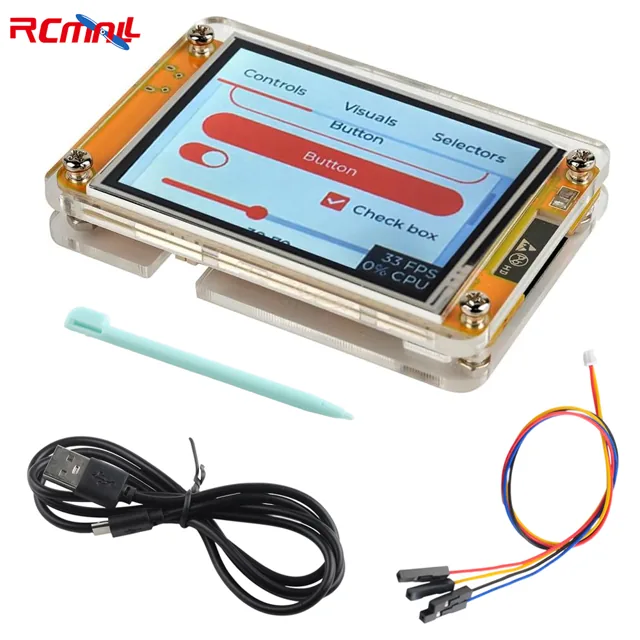
The cheapest way to get an ESP32 with a colour touchscreen on one board. A huge community has grown around it for smart-home panels, dashboards and retro UIs.
As an Amazon Associate and an affiliate we may earn from qualifying purchases. Prices and availability are set by the retailer.
At a glance
⚑ flag an error| SoC | ESP32 |
|---|---|
| Vendor | Sunton |
| Type | Display board |
| Memory | 4 MB flash |
| Display | 2.8" 240x320 TN (ILI9341 (ST7789 on 2-USB revision), SPI bus), resistive (XPT2046) touch |
| Connectivity | Wi-Fi, Bluetooth |
| USB | micro-USB or USB-C (revision-dependent) |
| Battery | No |
| Free GPIO | ~4 (after display/touch/SD) |
| Onboard extras | sd, rgb-led, light-sensor, speaker |
| Typical price | $8-15 (street, varies) |
Compare all ESP32 display boards in one table →
Good for
Works with
Firmware and UI-stack support, with a known-good starting point where one exists. "Community" means an unofficial but working config or port.
- ESPHome Community support config / port →
- LVGL / Arduino Community support config / port →
- Bruce / Marauder Community support config / port →
Gotchas to know
- Very few free GPIO; most pins are committed to the display, touch, SD, RGB LED and audio (roughly GPIO21/22/27 and input-only GPIO35 are broken out).
- Resistive touch (XPT2046) needs calibration.
- Check which revision you get: original micro-USB (ILI9341) vs the 2-USB 'CYD2USB' (ST7789 — needs display inversion, and its USB-C port lacks CC resistors so C-to-C cables won't power it).
- Display, touch and SD sit on three separate SPI buses; batches also vary (driver IC, LDR, button positions), so match any guide to your exact revision.
- 5 V USB only.
Variants
Sunton family, named <resolution><S-size><touch> (N=none, R=resistive, C=capacitive): 2432S024 (2.4"), 2432S028R/C (2.8", the classic), 3248S035R/C (3.5"), 8048S070 (7"). See the CYD family guide.
The ESP32 inside
This board is built on the ESP32 (ESP32 (classic)). It uses the ESP32-WROOM-32 module.
Bare modules on the same SoC:
Adding sensors?
Presence radars, climate, CO2, energy — the sensor comparison table covers what people actually wire to these boards, with ESPHome support status and clone-risk ratings per part. This board has few free pins (see above) — favour I2C sensors, which share two pins.
Resources
Community guides usually go deeper than this page: pinout diagrams, wiring, library setup and copy-paste example code from people who build with these boards daily.