Guition JC4827W543 (4.3" ESP32-S3)
Also known as: JC4827W543 · JC4827W543C · Guition 4.3 inch ESP32-S3
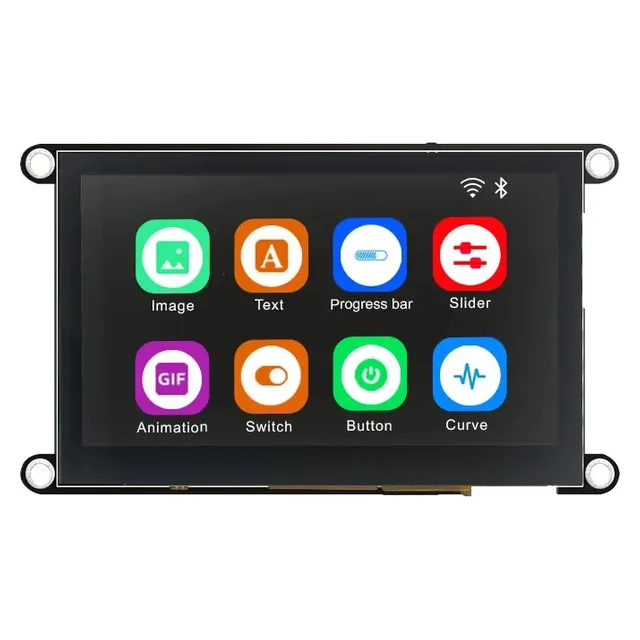
A 4.3" capacitive touch panel on an ESP32-S3 for around $12 — the successor to Sunton's 4827S043 and one of the cheapest routes to a decent-sized LVGL UI. Officially supported by openHASP.
As an Amazon Associate and an affiliate we may earn from qualifying purchases. Prices and availability are set by the retailer.
At a glance
⚑ flag an error| SoC | ESP32-S3 |
|---|---|
| Vendor | Guition (Shenzhen Jingcai) |
| Type | Display board |
| Memory | 4 MB flash · 8 MB PSRAM |
| Display | 4.3" 480x272 IPS (NV3041A, QSPI bus), capacitive (GT911) on -C SKU; -R/-N variants exist touch |
| Connectivity | Wi-Fi, BLE 5 |
| USB | USB-C |
| Battery | No |
| Onboard extras | sd |
| Typical price | $10-14 (street, varies) |
Compare all ESP32 display boards in one table →
Good for
Works with
Firmware and UI-stack support, with a known-good starting point where one exists. "Community" means an unofficial but working config or port.
- ESPHome Community support config / port →
- openHASP Official support config / port →
- LVGL / Arduino Community support config / port →
Gotchas to know
- Only 4 MB flash (N4R8) — large LVGL/ESPHome builds get tight; there is no 16 MB SKU.
- The NV3041A needs colour-invert + byte-swap settings, and only 0°/180° rotation works.
- In Arduino_GFX, SD-card and touch access can break after a display flush (shared bus quirk) — order operations carefully.
- 480x272 is a low resolution for 4.3" — fine for control panels, chunky for dashboards.
Variants
JC4827W543 N/R/C (none/resistive/capacitive touch). Successor to the Sunton ESP32-4827S043; same 480x272 panel class but QSPI instead of RGB, freeing GPIO.
The ESP32-S3 inside
This board is built on the ESP32-S3 . See the SoC page for the full peripheral, GPIO and security details.
Bare modules on the same SoC:
Adding sensors?
Presence radars, climate, CO2, energy — the sensor comparison table covers what people actually wire to these boards, with ESPHome support status and clone-risk ratings per part. Radars want a hardware UART; I2C sensors chain on two pins.
Resources
Community guides usually go deeper than this page: pinout diagrams, wiring, library setup and copy-paste example code from people who build with these boards daily.