Sunton ESP32-8048S070 (7" RGB panel)
Also known as: ESP32-8048S070 · Sunton 7 inch ESP32-S3 · 8048S070C
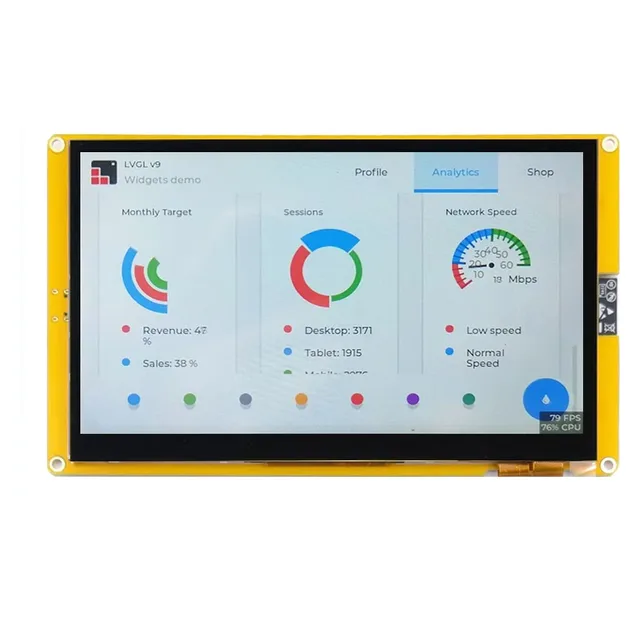
The cheapest way to a 7" touch dashboard: ESP32-S3 N16R8 driving an 800x480 parallel-RGB panel with GT911 capacitive touch for ~$22. The default budget pick for Home Assistant wall dashboards.
As an Amazon Associate and an affiliate we may earn from qualifying purchases. Prices and availability are set by the retailer.
At a glance
⚑ flag an error| SoC | ESP32-S3 |
|---|---|
| Vendor | Sunton |
| Type | Display board |
| Memory | 16 MB flash · 8 MB PSRAM |
| Display | 7" 800x480 IPS (ST7262 (RGB panel), RGB bus), capacitive (GT911); -N/-R variants exist touch |
| Connectivity | Wi-Fi, BLE 5 |
| USB | USB-C |
| Battery | No |
| Free GPIO | ~2 (after display/touch/SD) |
| Onboard extras | sd, speaker |
| Typical price | $21-28 (street, varies) |
Compare all ESP32 display boards in one table →
Good for
Works with
Firmware and UI-stack support, with a known-good starting point where one exists. "Community" means an unofficial but working config or port.
- ESPHome Community support
- LVGL / Arduino Community support config / port →
Gotchas to know
- The 800x480 framebuffer must live in PSRAM — expect flicker/tearing under Wi-Fi load unless you use LVGL bounce buffers / XIP-from-PSRAM tuning.
- The RGB bus consumes nearly every GPIO; almost no pins left for sensors (use I2C on the shared connector).
- Board revisions v1.1 vs v1.3 need different init code, and pinouts published for the 4.3" (8048S043) are wrong for the 7".
- Check the panel SKU: sibling 4827S043 is a TN panel with narrow viewing angles; for a wall panel you want this IPS 800x480 class.
Variants
Sunton 8048 family: S043 (4.3"), S050 (5"), S070 (7") — all 800x480 RGB on ESP32-S3 N16R8, N/R/C touch suffixes. The 4827S043 (480x272 TN) is the cheaper, worse sibling.
The ESP32-S3 inside
This board is built on the ESP32-S3 . See the SoC page for the full peripheral, GPIO and security details.
Bare modules on the same SoC:
Adding sensors?
Presence radars, climate, CO2, energy — the sensor comparison table covers what people actually wire to these boards, with ESPHome support status and clone-risk ratings per part. This board has few free pins (see above) — favour I2C sensors, which share two pins.
Resources
Community guides usually go deeper than this page: pinout diagrams, wiring, library setup and copy-paste example code from people who build with these boards daily.