HLK-LD2410 (B/C)
Also known as: LD2410 · LD2410B · LD2410C · Hi-Link LD2410 · Presence & motion
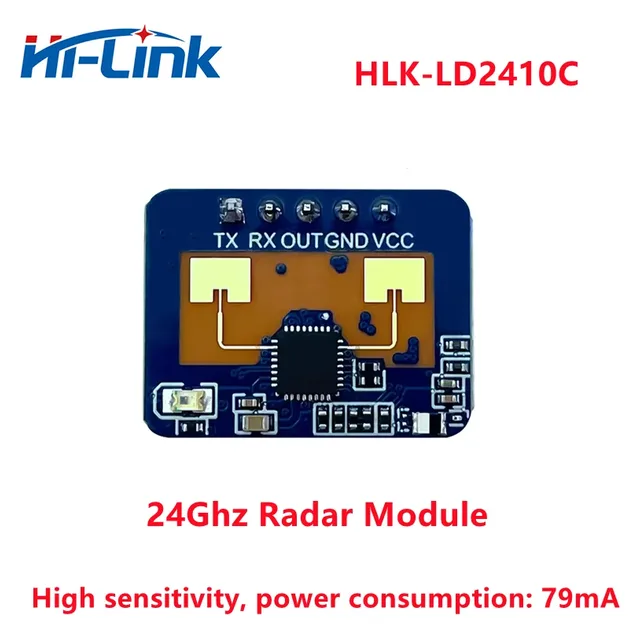
The default DIY mmWave presence sensor: it sees you sitting still, which PIR can't. It's the radar inside the Apollo MSR-2 and Everything Presence One, and the reason 'lights that never turn off on you' became a solved problem.
As an Amazon Associate and an affiliate we may earn from qualifying purchases. Prices and availability are set by the retailer.
At a glance
⚑ flag an error| Measures | presence, motion |
|---|---|
| Accuracy | 24 GHz FMCW radar; static + moving detection to ~6 m, per-gate energy levels |
| Interface | UART (256000 baud + OUT pin for standalone use) |
| Supply | 5 V (3.3 V logic) |
| Battery-viable | No (continuous draw) |
| ESPHome | Native ESPHome component — ld2410 |
| Typical price | $3-6 (street, varies) |
Compare all sensor modules in one table →
Which one do I buy?
LD2410 = plain zone presence. LD2412 = same job, better at stationary people, ~9 m. LD2450 = tracks up to 3 moving targets with X/Y position but is weak at static presence — high-end builds pair a 2450 with a 2410/2412.
Clone check
Good for
Gotchas to know
- Needs gate/sensitivity tuning: fans, curtains and HVAC cause false positives out of the box.
- B vs C: LD2410B has Bluetooth for the config app; LD2410C is cheaper with a plain pin header. Same radar.
- Ceiling is ~6 m and it senses through thin walls — placement matters more than specs.
- Not battery-viable (~80 mA continuous); for battery, the LD2410S variant exists.
Wiring it up
Give it a hardware UART (UART1/2 on any ESP32) rather than software serial — the radars talk at 256000 baud. Any dev board works; the DevKitC class is the default host, and if you're building a sensor-plus-screen device, pick a display board with spare pins like the JC3248W535.